
LEVY INNOVATION

Freewriting

Make Your Elevator Speech Distinctive

When people ask what I do for a living, I can’t help but smile. I tell them the following: “Consultants and entrepreneurial companies hire me to help them increase their fees by up to 2,000%.”

I must have delivered that elevator speech a thousand times, and every time it’s gotten me that treasured response: “How do you do that?”

I didn’t always have a good speech. I used to talk about how I made people memorable or compelling or made them stand out. Now, there’s nothing wrong with saying those things. I still say them. But I was uncomfortable making claims without supplying facts to back them up. So I went hunting for the facts.

Using the freewriting technique I teach in “Accidental Genius,” I typed into my computer as fast as I could for a couple of hours about who my clients were, why they hired me, and how I’d helped them. I wasn’t straining to find the exact right thing to say. I was merely talking to myself about my business while doing a freeform information dump.

One of the things I wrote about was what had happened once my clients adopted the positions I created for them. Did  they become  famous? Find more prospects? Work on better  projects? If so, where was the proof? What were the facts?

I happened upon fees. A client who used to charge $1,000 for an engagement, now charged $20,000. Hmm. A second client, who used to charge $350 an hour, now made $25,000 a day. Huh. A third client, who had been asking $3,000 for a keynote speech, now commanded $20,000. Hah. A pattern was forming.

I was a positioning consultant and writing coach, sure. But I was also the guy whose work helped clients “raise their fees by up to 2,000%.” My assertion was an attention-grabber, in part, because it wasn’t based on some notion I cooked up. It was based on facts.

The right facts make you distinctive.

When people ask me about creating their own elevator speech, I tell them to first list as many facts as they can about their business. Facts about their clients, process, services, products, results, philosophy, guarantees, and background, among other things. Obvious stuff. A long undifferentiated list.

I then ask that they look through that list for distinctive facts. In other words, which items on the list stand out? Which are interesting? Which are unusual? Which tell a story?

When looking for distinctions, some people freeze up. They think that finding distinctions is a special skill. It’s not. Most of us already know how to do it perfectly. We could do it in our sleep. It’s no harder than when we talk about a movie.

If a friend asked about a movie you just saw, you wouldn’t hesitate until you found just the right thing to say. You wouldn’t recount every scene. Instead, you’d head straight for something distinctive:

  • “It’s about a robot that travels back in time to protect its inventor.”
  • “It’s a horror film in 3-D.”
  • “It’s based on a play that won the Pulitzer.”
  • “It’s the new Daniel Day-Lewis film.”

Finding business facts to talk about is no different. Let yourself experiment. Look over your fact list, search it for distinctions, and write elevator speeches around those distinctions:

[For a business development consultant] “I design sales pipelines for small businesses that bring in, on average, an additional two hundred thousand dollars in revenue during the first six months alone.”

[For a productivity consultant] “Organizations like HP and Proctor & Gamble hire me to set up their employee rewards programs.”

[For a fitness trainer] “For eight years, I was a Marine Lieutenant. Now I teach people how to be as fit and tough as a combat Marine.”

The purpose of an elevator speech is to get the right people interested in you. It’s to start a conversation.

You may not find the proper speech right away. As you do more projects, come back to the exercise and add facts and distinctions to your list, and see how those might change the elevator speeches you’ve written.

Make Your Elevator Speech Distinctive Read More »
Telling the Same Story Differently

A few years ago, Matt Madden wrote and illustrated a book of cartoons called, “99 Ways to Tell a Story.” In it, he tells a single story 99 times – in 99 different ways.

The single story is itself uneventful. A man, working on his laptop, gets up and heads towards the kitchen. A voice at the top of the stairs calls out, “What time is it?” The man glances at his wristwatch and says “It’s 1:15.” He opens the refrigerator and scowls, because he’s forgotten what he was looking for. End of story.

Madden first tells it as a monologue. He then tells it from the man’s point of view. He also tells it as a how-to, a flashback, a comedy, a calligram, a public service announcement, a political cartoon, in silhouette, in close-ups, from the refrigerator’s point of view, as if it were overheard in a bar, and as a homage to Marvel illustrator Jack Kirby, among other inventive ways.

Any story can be told from dozens of angles, in countless styles. Each angle and style reveals something previously hidden. It’s an important principle to remember, and doesn’t only apply to cartoons or even fiction. The idea of differing angles and styles is something to think about for your business communications.

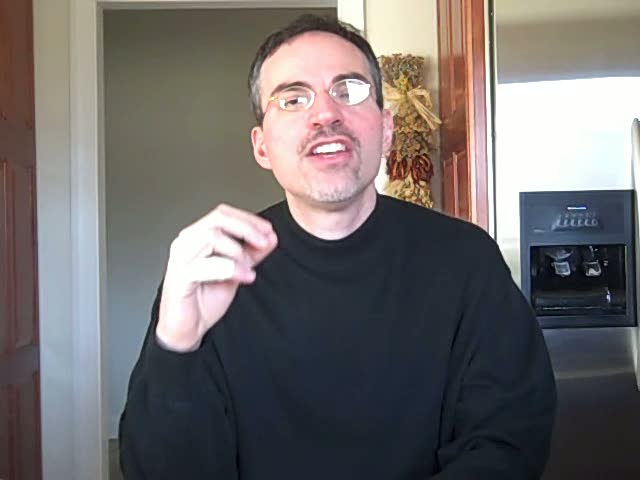
Two weeks ago, Kristen Frantz from Berrett-Koehler Publishers asked me to make a video about the forthcoming edition of my book, “Accidental Genius.” The reason: Berrett-Koehler uses a prominent outside sales rep group, Ingram Publisher Services, to sell its books to bookstores, and Kristen thought it would be good if at sales conference the group saw how committed to selling the book I am.

I never before made a video. The result was too long, even though I had left out some important information. I’d have to reshoot it. The thing puzzling me, though, was this:

How could I make a shorter video while giving my audience more information?

Kristen and I came up with a simple strategy. I divided all my information into talking points. Some of those talking points seemed like they should come from my mouth: the book’s main idea, the philosophy behind it, the story of my eighteen years as a bookseller and my understanding of what a crucial job the sales rep has in the selling of a book. Those I filmed, and are in the video below.

Other points, like who’s in my network and how I plan on supporting the book, were important, but didn’t seem like they needed to come directly from me. Kristen, we decided, would talk about those points live at the conference.

Our solution wasn’t a complicated one, but it did the trick. We took a video with too much information, and made it more palatable by breaking its points into recorded and live moments. An optical illusion of sorts.

Take a look. Perhaps my video or performance skills aren’t what they should be yet, but the idea is still valid: Don’t think you’re stuck with one or two ways of delivering information to your audience. Try a different angle. Graft together uncommon styles. You may be surprised at the result.

By the way, near the end of the video you’ll hear me say, “I told you I’m a magician,” and then I perform a small trick. Unfortunately, I had edited out an earlier part of the video where I discussed my background as a magician and professional illusion inventor. Kristen told me not to sweat it. She’d add that to her talking points during the live session.

Telling the Same Story Differently Read More »

Writing a Sticky Title

Let’s begin with a quiz. Below you’ll find a list of book titles. All are genuine titles from published books – except for one. See if you can spot that lone non-book-title.

1. “Theodore Roosevelt on Leadership”

2. “Curious George and the Pizza”

3. “Soon I Will be Invincible”

4. “The Confident Leader”

5. “Virtual Learning”

6. “Sixty Stories”

7. “Apathy”

8. “The internet isn’t that big a deal. Neither is the PC. Abandon all technology and live in the woods for a week and see if it’s your laptop you miss most. In fact, the technologies most important to us are the older ones – the car and telephone, electricity and concrete, textiles and agriculture, to name just a few. The popular perception of modern technology is out of step with reality. We overestimate the importance of new and exciting inventions, and we underestimate those we’ve grown up with.”

Think you know the answer? We’ll get back to the quiz in a moment, and see if you’re right.

Two Methods of Titling a Book

As a book-writing coach for businesspeople, I’m often asked about how to come up with a sticky title. I have a bag of titling tricks, but here are two of my favorites:

Sticky Trick 1. If the writer has written a book draft or proposal, I ask that they print it out, and underline all the interesting ideas and turns-of-phrase they see. We then comb through their work and make up dozens of titles based on every promising phrase they’ve highlighted.

The advantage of this approach: The titles we create are  based on the writer’s organic material. That is, rather than focusing everything on the book’s generic idea (for instance, how to be more productive), we can look for how the writer makes their point  in distinctive ways (how to be more productive by being “unreasonable”).

Distinct ideas and phrases are what’s going to make the book stand out in the marketplace when it’s published, so why not start titling it from there?

Sticky Trick 2. The writer and I visit bricks-and-mortar and online bookshops, and we see which book titles catch our attention. Those attention-grabbers act as thought starters, and inspire us to come up with fresh titles.

This method harkens back to the quiz I asked you to take. You looked at eight choices and picked the one that wasn’t a published book title. The answer, of course, is choice 8 (“The internet isn’t that big a deal . . . ,“ which is from Bob Seidensticker’s excellent book, “Futurehype: The Myths of Technology Change”).

I’m certain you selected the correct answer, but how did you know it was correct?

Obviously, book titles follow certain rules of thumb. Perhaps you’ve never articulated these rules, but you know many of them inherently. They’re a part of you.

You know, for instance, that a title must be short. While choice 8 was a powerful piece of prose and encapsulated the main idea of Bob’s book, it violated the brevity titling rule.  Therefore, it couldn’t have been the title. (A number of books have had lengthy titles for novelty’s sake. The longest title on record, which celebrates the career of “Harry Potter” actor Daniel Radcliffe, is 4,805 characters.)

What are some other rules for titling a book? Again, an easy way of reminding yourself of rules you already know, or of finding new ones, is by studying existing books and extracting the concepts they use.

Look, for example, at my book, “Accidental Genius.” The title was inspired by a quote from Samuel Johnson. One rule, then, might be, “Title your book using a full or condensed quote.” A second rule could be, “Put together two conflicting words (like ‘Accidental’ and ‘Genius’) that intriguingly point to your book’s main premise.”

Tweetable Titles

Roger C. Parker, a smart and prolific writer who has penned 38 books, has collected dozens of titling rules, and has published them in a book called “#Book Title Tweet.”

The work’s central premise: for a title to be effective, it’s got to be able to “communicate at a glance.” The discipline of training yourself to write Twitter-friendly titles, then, is a useful one. Roger’s book, in fact, dispenses its wisdom in approximately 140 tweet-sized chunks, including:

  • “[P]osition your topic by making it obvious whom you are not writing for, e.g., ‘Design for Non-Designers.’”
  • “Target your title to a specific circumstance, e.g., ‘How to Sell When Nobody’s Buying.”
  • “Position your book by projecting an ‘attitude,’ – ‘Mad Scam: Kick-Ass Advertising Without the Madison Avenue Price Tag.”
  • “Issue an engaging command and explain it, e.g., ‘Don’t Make Me Think: A Common Sense Approach to Web Usability.”
  • “Ask a question while stressing your unique qualifications, e.g., ‘What Can a Dentist Teach You about Business, Life, & Success?’”

Besides titling tactics, Roger shares bite-sized research and survey tips, and cautions.

At 130-odd pages, “#Book Title Tweet” is a speedy read, the information in it is first-rate, and the importance of its concept is undeniable.

After all, without a strong title, it doesn’t matter how good your content is — no one will read your book, white paper, or article, click on your video, or attend your event.

You owe it to yourself and your work, then, to devise titles that stick in the mind or prompt a click.


Writing a Sticky Title Read More »

Creating Content the Frankenstein Way

I was in the library doing research on Viktor Frankl — the concentration camp survivor who went on to write one of the world’s most influential books, “Man’s Search for Meaning” — when I punched his name into the automated inventory system. The titles of  his books appeared on the screen . . . along with a suggestion by the computer. It read:

“Searching for: Viktor Frankl. Did you mean: Victor Frankenstein?”

I was so pleased by the machine’s out-of-left-field suggestion, that I thought of calling over a few random library patrons for a look. Instead, a better idea came to me.

Since one of the principles of freewriting (and improv) is “using what you’re given,” I decided to employ “Frankenstein” as serendipity. That is, rather than devoting the day’s research to Frankl, I wondered if I could derive any creativity principles worth sharing by researching the famed horror story.

Thanks to Susan Tyler Hitchcock’s fascinating volume, “Frankenstein: A Cultural History,” by day’s end I’d found dozens of such principles. In particular, the tale of how the novel came to be written is rife with ideas that would be helpful to any content creator.

How “Frankenstein” Came to Be Written

In 1816, Lord Byron, his traveling companion, John William Polidori, Percy Shelley, and Shelley’s soon-to-be wife, Mary Godwin (later, “Mary Shelley”), were all staying near Lake Geneva in Switzerland.

The four spent much of their time debating controversial issues concerning life and death, particularly in the realm of science. Among other things, they likely discussed Joseph Priestley’s experiments with vegetables and mold, Luigi Galvani’s work with “animal magnetism,” and Luigi Aldini’s exhibitions using electricity to animate dead frogs, oxen heads, and the body and features of an executed killer.

The group also talked  literature. One book they’d brought along was a badly-written story collection about the supernatural, “Phantasmagoriana.”

“After listening to a few of these tales,” writes Hitchcock, “Byron challenged his companions. Any one of them could do better.” An impromptu contest was arranged, Each member of the group would write a ghost story. The result?

Shelley, who’d soon be recognized as a great poet, apparently never wrote a word of his yarn.

Byron, who was already a rising star in the literary sky, wrote a two thousand word piece about two men in a cemetery, and stopped before it was finished.

Polidori, Byron’s traveling companion who had more of a background in medicine than he did as a writer, wrote two stories; the second of which, “Vampyre,” became a sensation in Europe and later helped inspire Bram Stoker to pen “Dracula.”

Mary Godwin, whose parents were renowned authors but who, like Polidori, was not yet considered a writer, struggled for days in coming up with an idea. She was blocked.

Godwin Heeds an Image

One night, as she lay in bed with eyes closed but unable to sleep, a scene appeared in her mind. She saw, in her own words, a “pale student of unhallowed arts kneeling beside the thing he had put together,” which she soon recognized as a “hideous phantasm of a man stretched out.” Then, “on the working of some powerful engine,” the phantasm showed “signs of life.”

Godwin was so unnerved by the image that she opened her eyes and looked around her darkened room as a means of distracting herself. When that didn’t work, she decided to think about a plot for her ghost story. “O! if I could only contrive one which would frighten my reader as I myself had been frightened that night!,” she later wrote.

The answer to her ghost story problem suddenly hit her. Hitchcock writes: “Soon the two thoughts merged into one: her waking dream was her ghost story.” Months later, the first version of her novel was completed.

The Takeaways

Some of the lessons I take away from this story, and that might be of benefit to you, include the following:

1. You needn’t be a noted expert to write something that shakes up and sticks with an audience. Lord Byron and Percy Shelley are considered poets of the highest stripe, yet few read their work today. The characters and influences from Mary Godwin’s and John William Polidori’s work, however, continue to fascinate us.

2. When it comes to creating, arrange for a little friendly competition. Godwin did indeed write “Frankenstein” and Polidori’s effort inspired “Dracula,” but the unsung hero of the affair is Byron. Without his good-natured challenge it’s unlikely that either writer would have written a supernatural tale – then or ever. Said differently: Had Byron not been playful and competitive, the world may never have heard of “Frankenstein” or “Dracula.”

3. Learn from other fields. “Frankenstein” is a work of fiction, yet Godwin wrote it by combining the ideas she and her companions were discussing from the fields of science and philosophy. She didn’t limit her interests to poems and novels. She let the whole world in.

4. Pay attention to images. Godwin didn’t know why the “hideous phantasm” image appeared to her, and although she tried to forget it, she quickly learned the power of paying attention to such a vivid and unexplained flash of insight.

Our minds aren’t neatly ordered, and important ideas at times bubble to the surface in ways that are seemingly illogical and non-verbal.

If you want to write deeply about a topic, I can’t give you better advice than to do fast, exploratory writing about the scenes and snapshots that drift through your mind as you consider it.

Creating Content the Frankenstein Way Read More »