




















List-Making as a Tool of Thought Leadership

{ 9 comments }

To prepare for a workshop I’m giving, I’ve spent hours doing exploratory writing on how to create an elevator speech.

On the page, I’ve asked and answered questions like, “What’s an elevator speech supposed to accomplish?,” “What are the best ones I’ve heard?,” and “What are the worst ones?”

I’ve also made a list of elevator speech ingredients. Most of them, naturally, are the things you’d expect. A good speech mentions one’s target market, product or service, and benefits to the customer.

One of the ingredients I came up with, though, is more unusual. You rarely hear about it in business literature. That often overlooked ingredient is honest detail.

To better describe what I mean by honest detail, which might also be called “telling detail,” let’s turn to an outside source: novelist and essayist, George Orwell.

A Detail Saves a Life

In late 1936 to early 1937, Orwell fought in the Spanish Civil War. During one battle he was shot in the throat. Orwell not only recovered, but in the ensuing twelve years he penned his most notable books, “Animal Farm” and “Nineteen Eighty-Four.”

He also wrote an essay, “Looking Back on the Spanish Civil War,” which included the following passage:

“At this moment a man, presumably carrying a message to an officer, jumped out of the trench and ran along the top of the parapet in full view. He was half-dressed and was holding up his trousers with both hands as he ran. I refrained from shooting at him . . . I did not shoot partly because of that detail about his trousers. I had come here to shoot at ‘Fascists’; but a man who is holding up his pants isn’t a ‘Fascist,’ he is visibly a fellow-creature, similar to yourself, and you don’t like shooting at him.”

In analyzing this passage in their textbook, “Finding Common Ground,” educators Carolyn Collette and Richard Johnson write: “The life of Orwell’s enemy may have been spared because Orwell noticed a detail, the man holding his pants up with both hands – an awkward, slightly comical, and bizarre detail; lifelike in the extreme . . . “ (p. 4)

The honest detail, “lifelike in the extreme,” can persuade. The telling image – drawn, not from the mind, but from reality — can capture people’s attention and coax them into action.

Most business writing, especially elevator-speech writing, lacks such realism and candor. It stays on the surface, espousing “big ideas” through generalization and abstraction. The writer ends up saying what they think they’re supposed to say, instead of what’s real. Their words don’t make a dent in anybody’s mind.

Statistics as Detail

When I started Levy Innovation, my elevator speech used to talk about how I helped make people memorable and compelling. As I’ve written before, there was nothing wrong with saying those things. I still say them. What I hated was talking about those concepts in unsubstantiated form. Without supporting facts and detail drawn from life, they were mere opinion.

As I examined my projects for facts, I realized something that had previously escaped me. Due in part of my efforts, several clients had become popular enough to raise their fees by 600%, 800%, and even 2,000%.

Figures like those became my substantiation — my telling detail. When asked what I did, I began saying: “Consultants and entrepreneurial companies hire me to help them increase their fees by up to 2,000%.”

Painting a Candid Picture

While creating elevator speeches for other situations, I always sought that telling detail to make my point. Sometimes the detail came in the form of a statistic. Other times it came by painting a picture that let the listener know I understood what they might be going through.

For instance, if I met a consultant who explained their services awkwardly or seemed embarrassed as they spoke, I’d introduce my work in the following way:

“You know how when a businessperson meets a prospect, say, at a conference, and that businessperson starts talking  about who they are and what they do, and the prospect starts looking right past them to see if there’s anyone in the room who is ‘more important’?

“So, not only has that businessperson lost any chance to gain a client, but they also feel awful about their life, because they put so much effort into their business, and this prospect looking past them is, in a way, dismissing their entire being. (At least that’s what it feels like to them.)

“Well, what my work does is to help people like that businessperson who find it tough explaining what they do and why their work matters. I counsel them on writing elevator speeches and talking points that hold attention and make prospects eager to have a conversation with them.”

More times than not, the person I was talking to wanted to find out more about how my work might help them, because the details of the picture I painted struck them as undeniably real.

(Where, you might wonder, did I get those details? From my own life. A couple of decades ago, while I was in my early twenties and manned the trade show booth for a book wholesaler, attendees would ask me, “What does your company do?” As I explained, they’d at times leave while I was in mid-sentence. You don’t forget a detail like that.)

“Help me! Help me!”

The other day I spoke with a consultant, Kathy Gonzales,  whose elevator speech delighted me. It’s not because Kathy meticulously crafted every word, or delivered the speech with flair. It was the realism of her detail. Her speech sounded like it came straight from life. When I asked what she did, she said:

“I work with executives, mostly men, who want to leave the corporate world and start their own business. I don’t make them better at what they want to do. I won’t make a financial planner a better financial planner, or a baker a better baker. I just help them make the jump. They’ve got one hand on the corporate ledge, and they want to let go, but they’re crying, ‘Help me! Help me!’ That’s my client.”

Notice how Kathy didn’t make a lot of promises or claims. That adds to the persuasiveness of her speech.

I don’t know anything about Kathy’s company, Modern Happiness, and I’m not in the market for her type of service. But if I was, I’d be intrigued enough to have an initial chat – a “How do you do that?” talk — and that’s what an elevator speech is supposed to accomplish, isn’t it?

Your Challenge

If you’re struggling to come up with an elevator speech that captures attention, here’s an assignment using a standard speech format:

Think about the three most common problems your product or service solves, and create a speech for each. Don’t labor over the speeches, though. Just talk them out. Consider recording them as you go.

As I did in a speech above, begin with the phrase, “You know how when . . . ,” and describe the type of person you serve and the problem they experience in as much honest detail as you can. Stay true to what really happens. Don’t think you need to make things sound more dramatic than they are.

Once you’ve painted the scene, talk about what your work does to alleviate the problem you mentioned.

You may not get the most telling details right away — the ones, “lifelike in the extreme.” If  not, don’t sweat it. As you do your project work throughout the day, pay attention to what really happens and try incorporating the most intriguing facts into future drafts of  your speeches.

{ 8 comments }

I asked my friend, Jake Jacobs, how business was doing, and expected a mechanical response, like “Things are good” or “Can’t complain.”

Instead, he told me he’s having the most profitable twelve months he’s had in twenty-five years as a consultant – and that’s in a down economy. This year, in fact, his firm is exceeding last year’s revenue by 170%.

How’d that happen?

A few months back, Jake did a little soul searching, and decided he wanted his company, Winds of Change Group, to hit the five-million-dollars-a-year revenue mark. Reaching that figure, though, would represent a jump. A jump that would take considerable time.

Jake, however, didn’t want to wait.

He knew if his company was to have any kind of shot of reaching that goal sooner rather than later, they couldn’t continue doing things the way they’d been doing them. To find out exactly how they should change, Jake took an unusual approach:

He projected himself into the future, and found his answers there.

That is, he didn’t first look at how his company could inch-ahead with what they were currently doing. Instead, he conducted a thought experiment, and imagined himself in the near-future heading a consultancy that was doing five million dollars business a year already.

A Vivid Daydream

During the experiment, which was something of a vivid daydream, Jake looked at each part of his firm and noted how they were conducting business. He saw who they had as clients, what services they were offering, how they closed deals, and how they delivered upon promises.

After conducting the thought experiment, Jake shared what he saw with his colleagues. Together they began taking immediate action on as many of his future-focused tactics as they could – thus behaving as if they were a five million dollar firm in the here and now.

They haven’t yet hit their revenue goal, but with increases of 170%, hitting that figure shouldn’t take long.

What tips can Jake share about his living-in-the future approach?

  • “When you’re looking around in the future, don’t just see the big stuff, like who your clients will be. You’ve got to study every nook and cranny of your organization. So, if you’re looking at your future company, see how it would celebrate its successes. What would its parties look like?”
  • “As much as possible, make that preferred future real today. Doing the stuff you’ve brought back is energizing. You start seeing results and evidence of change immediately. The more things change, the more your people see that they’re changing, the more likely they are to push for more change. It’s self-reinforcing.”
  • “You can use this method in any aspect of your life. Why not have an image of the next hour being the way you want it to be. Give it a try, and check in sixty minutes later to see how it works.”

Your Assignment

Try Jake’s preferred future exercise during your next bout of freewriting.

First, do a twenty minute session on what your dearest business goals might be, and what your company would look like once you’ve reached them.

Second, do another twenty minute session on what you learned during the first session, and what you could apply to your business today if you chose to.

{ 2 comments }

Writing a Sticky Title

by Mark Levy

Let’s begin with a quiz. Below you’ll find a list of book titles. All are genuine titles from published books – except for one. See if you can spot that lone non-book-title.

1. “Theodore Roosevelt on Leadership”

2. “Curious George and the Pizza”

3. “Soon I Will be Invincible”

4. “The Confident Leader”

5. “Virtual Learning”

6. “Sixty Stories”

7. “Apathy”

8. “The internet isn’t that big a deal. Neither is the PC. Abandon all technology and live in the woods for a week and see if it’s your laptop you miss most. In fact, the technologies most important to us are the older ones – the car and telephone, electricity and concrete, textiles and agriculture, to name just a few. The popular perception of modern technology is out of step with reality. We overestimate the importance of new and exciting inventions, and we underestimate those we’ve grown up with.”

Think you know the answer? We’ll get back to the quiz in a moment, and see if you’re right.

Two Methods of Titling a Book

As a book-writing coach for businesspeople, I’m often asked about how to come up with a sticky title. I have a bag of titling tricks, but here are two of my favorites:

Sticky Trick 1. If the writer has written a book draft or proposal, I ask that they print it out, and underline all the interesting ideas and turns-of-phrase they see. We then comb through their work and make up dozens of titles based on every promising phrase they’ve highlighted.

The advantage of this approach: The titles we create are  based on the writer’s organic material. That is, rather than focusing everything on the book’s generic idea (for instance, how to be more productive), we can look for how the writer makes their point  in distinctive ways (how to be more productive by being “unreasonable”).

Distinct ideas and phrases are what’s going to make the book stand out in the marketplace when it’s published, so why not start titling it from there?

Sticky Trick 2. The writer and I visit bricks-and-mortar and online bookshops, and we see which book titles catch our attention. Those attention-grabbers act as thought starters, and inspire us to come up with fresh titles.

This method harkens back to the quiz I asked you to take. You looked at eight choices and picked the one that wasn’t a published book title. The answer, of course, is choice 8 (“The internet isn’t that big a deal . . . ,“ which is from Bob Seidensticker’s excellent book, “Futurehype: The Myths of Technology Change”).

I’m certain you selected the correct answer, but how did you know it was correct?

Obviously, book titles follow certain rules of thumb. Perhaps you’ve never articulated these rules, but you know many of them inherently. They’re a part of you.

You know, for instance, that a title must be short. While choice 8 was a powerful piece of prose and encapsulated the main idea of Bob’s book, it violated the brevity titling rule.  Therefore, it couldn’t have been the title. (A number of books have had lengthy titles for novelty’s sake. The longest title on record, which celebrates the career of “Harry Potter” actor Daniel Radcliffe, is 4,805 characters.)

What are some other rules for titling a book? Again, an easy way of reminding yourself of rules you already know, or of finding new ones, is by studying existing books and extracting the concepts they use.

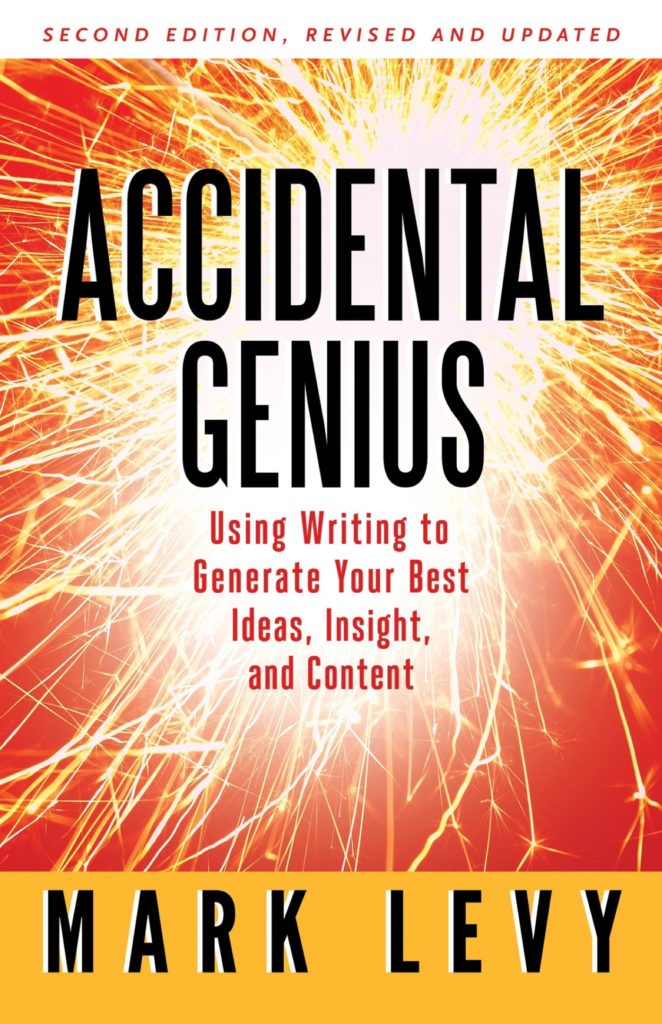
Look, for example, at my book, “Accidental Genius.” The title was inspired by a quote from Samuel Johnson. One rule, then, might be, “Title your book using a full or condensed quote.” A second rule could be, “Put together two conflicting words (like ‘Accidental’ and ‘Genius’) that intriguingly point to your book’s main premise.”

Tweetable Titles

Roger C. Parker, a smart and prolific writer who has penned 38 books, has collected dozens of titling rules, and has published them in a book called “#Book Title Tweet.”

The work’s central premise: for a title to be effective, it’s got to be able to “communicate at a glance.” The discipline of training yourself to write Twitter-friendly titles, then, is a useful one. Roger’s book, in fact, dispenses its wisdom in approximately 140 tweet-sized chunks, including:

  • “[P]osition your topic by making it obvious whom you are not writing for, e.g., ‘Design for Non-Designers.’”
  • “Target your title to a specific circumstance, e.g., ‘How to Sell When Nobody’s Buying.”
  • “Position your book by projecting an ‘attitude,’ – ‘Mad Scam: Kick-Ass Advertising Without the Madison Avenue Price Tag.”
  • “Issue an engaging command and explain it, e.g., ‘Don’t Make Me Think: A Common Sense Approach to Web Usability.”
  • “Ask a question while stressing your unique qualifications, e.g., ‘What Can a Dentist Teach You about Business, Life, & Success?’”

Besides titling tactics, Roger shares bite-sized research and survey tips, and cautions.

At 130-odd pages, “#Book Title Tweet” is a speedy read, the information in it is first-rate, and the importance of its concept is undeniable.

After all, without a strong title, it doesn’t matter how good your content is — no one will read your book, white paper, or article, click on your video, or attend your event.

You owe it to yourself and your work, then, to devise titles that stick in the mind or prompt a click.


{ 10 comments }

I was in the library doing research on Viktor Frankl — the concentration camp survivor who went on to write one of the world’s most influential books, “Man’s Search for Meaning” — when I punched his name into the automated inventory system. The titles of  his books appeared on the screen . . . along with a suggestion by the computer. It read:

“Searching for: Viktor Frankl. Did you mean: Victor Frankenstein?”

I was so pleased by the machine’s out-of-left-field suggestion, that I thought of calling over a few random library patrons for a look. Instead, a better idea came to me.

Since one of the principles of freewriting (and improv) is “using what you’re given,” I decided to employ “Frankenstein” as serendipity. That is, rather than devoting the day’s research to Frankl, I wondered if I could derive any creativity principles worth sharing by researching the famed horror story.

Thanks to Susan Tyler Hitchcock’s fascinating volume, “Frankenstein: A Cultural History,” by day’s end I’d found dozens of such principles. In particular, the tale of how the novel came to be written is rife with ideas that would be helpful to any content creator.

How “Frankenstein” Came to Be Written

In 1816, Lord Byron, his traveling companion, John William Polidori, Percy Shelley, and Shelley’s soon-to-be wife, Mary Godwin (later, “Mary Shelley”), were all staying near Lake Geneva in Switzerland.

The four spent much of their time debating controversial issues concerning life and death, particularly in the realm of science. Among other things, they likely discussed Joseph Priestley’s experiments with vegetables and mold, Luigi Galvani’s work with “animal magnetism,” and Luigi Aldini’s exhibitions using electricity to animate dead frogs, oxen heads, and the body and features of an executed killer.

The group also talked  literature. One book they’d brought along was a badly-written story collection about the supernatural, “Phantasmagoriana.”

“After listening to a few of these tales,” writes Hitchcock, “Byron challenged his companions. Any one of them could do better.” An impromptu contest was arranged, Each member of the group would write a ghost story. The result?

Shelley, who’d soon be recognized as a great poet, apparently never wrote a word of his yarn.

Byron, who was already a rising star in the literary sky, wrote a two thousand word piece about two men in a cemetery, and stopped before it was finished.

Polidori, Byron’s traveling companion who had more of a background in medicine than he did as a writer, wrote two stories; the second of which, “Vampyre,” became a sensation in Europe and later helped inspire Bram Stoker to pen “Dracula.”

Mary Godwin, whose parents were renowned authors but who, like Polidori, was not yet considered a writer, struggled for days in coming up with an idea. She was blocked.

Godwin Heeds an Image

One night, as she lay in bed with eyes closed but unable to sleep, a scene appeared in her mind. She saw, in her own words, a “pale student of unhallowed arts kneeling beside the thing he had put together,” which she soon recognized as a “hideous phantasm of a man stretched out.” Then, “on the working of some powerful engine,” the phantasm showed “signs of life.”

Godwin was so unnerved by the image that she opened her eyes and looked around her darkened room as a means of distracting herself. When that didn’t work, she decided to think about a plot for her ghost story. “O! if I could only contrive one which would frighten my reader as I myself had been frightened that night!,” she later wrote.

The answer to her ghost story problem suddenly hit her. Hitchcock writes: “Soon the two thoughts merged into one: her waking dream was her ghost story.” Months later, the first version of her novel was completed.

The Takeaways

Some of the lessons I take away from this story, and that might be of benefit to you, include the following:

1. You needn’t be a noted expert to write something that shakes up and sticks with an audience. Lord Byron and Percy Shelley are considered poets of the highest stripe, yet few read their work today. The characters and influences from Mary Godwin’s and John William Polidori’s work, however, continue to fascinate us.

2. When it comes to creating, arrange for a little friendly competition. Godwin did indeed write “Frankenstein” and Polidori’s effort inspired “Dracula,” but the unsung hero of the affair is Byron. Without his good-natured challenge it’s unlikely that either writer would have written a supernatural tale – then or ever. Said differently: Had Byron not been playful and competitive, the world may never have heard of “Frankenstein” or “Dracula.”

3. Learn from other fields. “Frankenstein” is a work of fiction, yet Godwin wrote it by combining the ideas she and her companions were discussing from the fields of science and philosophy. She didn’t limit her interests to poems and novels. She let the whole world in.

4. Pay attention to images. Godwin didn’t know why the “hideous phantasm” image appeared to her, and although she tried to forget it, she quickly learned the power of paying attention to such a vivid and unexplained flash of insight.

Our minds aren’t neatly ordered, and important ideas at times bubble to the surface in ways that are seemingly illogical and non-verbal.

If you want to write deeply about a topic, I can’t give you better advice than to do fast, exploratory writing about the scenes and snapshots that drift through your mind as you consider it.

{ 2 comments }

When it comes to business practices, what you’re confident about today may be proven wrong tomorrow. I’ll explain.

When I was a kid, I’d go to the candy store and spin the squeaky, revolving rack of comic books to see if it held a new issue of “Sergeant Fury,” “Captain America,” “Iron Man,” “Spider-Man,” or “Thor.” If I spotted one, I’d stare at its cover for a minute or two to get a sense if the story hidden inside promised to be worth twelve cents (or twenty-five cents for a double issue).

Why didn’t I judge the comic by thumbing through it? If I tried, the store owner would lean over his counter and shout: “This isn’t a library. Are you looking or buying?”

I’d be forced into buying, because “looking” was akin to theft.

When I was growing up, most stores dissuaded you from sampling a product. Their reasoning? Maybe they thought if you got even a taste for free you wouldn’t value the product enough to pay for it. Maybe they wanted customers to absorb the transactional risk and judge the quality of a product on their own dime.

Such thinking now, of course, is considered unenlightened. It hinders sales. Instead of keeping products away from customers, businesses try hard to get them into people’s hands.

Want to play around with a software program? No problem. Go for the free ninety-day trial and see if you like it. Want to know if a certain car hugs the road? Don’t sweat it. Take the auto home for a few days and test it.

Going from the “no sample” strategy to the “try the complete product for free” strategy is a radical about-face. But you and I have seen other strategy reversals just as drastic.

Years ago, it was assumed that the smartest person in most companies was the leader. After all, the leader was in charge of the organization for a reason. In many organizations, that thinking has now changed. They believe in the genius of the group, and think its people are smarter in the aggregate than they are separately. These organizations put collaboration tools in place, so people can more closely work together.

Along the same lines, many organizations used to assume that their employees couldn’t be trusted with sensitive information; the hierarchy, therefore, hoarded data. Now, thanks to the influence of practices like Open Book Management, certain leaders share financial and strategic information with the company, so employees can take responsibility and make better educated business decisions.

I could go on recounting business strategies, like Reengineering and Management by Objectives, which were once thought to be best approach to solving a particular problem, but are now looked upon, at best, as one tool in a diverse strategy toolkit. But I won’t. I know you get the picture.

The point I’m driving at is this: Right now, you and I are using strategies in our business that will, one day soon, be thought of as wrongheaded. We’ll look back and think, “How could I have wasted so much time believing that?” or “focusing on that?” or “doing that?”

Rather than waiting for that day to come, get a jump on uncovering those strategies and on hatching alternate ways of doing things.

Think of it as a game. Look at how you prospect and sell. Look at your products and services. Look at your infrastructure and how you get things done. Look at your pet philosophy and manifesto ideas.

Even if what you’re doing is working, pretend it’s not. Pretend it’s broken and you’ve got to come up with something new – you have no option.

What would you try?

Is there a way, even a small way, of trying it now?

{ 5 comments }

“That’s a post”

by Mark Levy

The other day I was on the phone with my friend and colleague, Nettie Hartsock, discussing our backgrounds as writers, when I mentioned an assignment I’d worked on that hadn’t turned out as planned.

Fifteen years earlier, a newspaper editor asked me to interview beauty-queen-and-singing-star Vanessa Williams. Although I wasn’t a fan of Williams’ Top 40 style of music, I consented. To prepare for the interview, I researched her music and career for a week. Unfortunately, the singer had a scheduling conflict and cancelled. Suddenly, I was stuck with a somewhat in depth knowledge of Williams’ work, and nowhere to use it.

Nettie laughed. She too had put in days on writing projects that had gotten the axe through no fault of her own. She said, “You should write up that story as a post.”

Hmm, I hadn’t thought of that.

A couple of months before my Nettie conversation, I was being toured through The National Press Club in Washington, DC by another friend and colleague, Sam Horn. I was to give a speech there about freewriting and problem-solving to Sam’s group, and she thought I’d enjoy knowing the club’s history.

As we wandered through the barroom, I broke away and ran to a framed sketch, hanging on the wall, of Dick Tracy. It wasn’t just any Tracy sketch. It was drawn especially for, and autographed to, The National Press Club by the character’s creator, Chester Gould. I told Sam:

“I can’t believe it. I’m inches away from the real Dick Tracy. I mean, Chester Gould drew this cartoon with his own hands.

“Seeing this takes me back to the late ‘60s when I was, like, six years old. My dad was alive, and Sunday morning’s he’d buy the New York Daily News, and it was divided into sections, and must have been a foot thick.

“I’d grab the comics section, it was in full color, and there on the cover, every week, was Gould’s Dick Tracy strip. I read it, kind of, but not really. I was more interested in playing with it.

“I’d spread the pages across the floor, take a hunk of Silly Putty, flatten it into a pancake, and smash it onto Dick Tracy’s face. When I peeled back the putty, a duplicate of his face would be stuck to it.

“I’d pull the putty wide, and Tracy’s face would expand. Then, I’d squish it into a ball, and his face would bunch up like a walnut. That Silly Putty was my seventy-nine cent version of Photoshop.”

When I finally wound down, Sam said to me: “Mark, that’s a post. Readers want to learn good, solid information they can use, but they also want to learn about the writer. You should write up that story.”

The idea hadn’t dawned on me.

Because of Nettie’s encouragement, the Vanessa Williams story appeared as my previous post. Thanks to Sam’s counsel, you’ve read the Dick Tracy anecdote here.

If you know a content creator, consider lending a hand by pointing out intriguing ideas and stories of theirs as they mention them. The immediacy of your remarks can be of  help.

If you yourself are a content creator, consider asking colleagues to do the same for you. If they think something you’ve said might interest a wider audience, suggest that they point it out.

We, of course, need to be the final judge as to what we create. Still, at times we get locked into our own theories as to what constitutes a useful and entertaining post or video. Getting a fresh perspective can shed light on an idea that we might have otherwise overlooked.

{ 2 comments }

In the mid-1990s I conducted interviews for a small entertainment newspaper. The editor was a friend who knew my tastes, so he gave me assignments I’d enjoy. I interviewed a pre-Titanic Leonardo DiCaprio, a rapper-turning-actor named “Marky Mark” Wahlberg, the art-house rocker Jim Carroll, and other artists who whose work was at the time considered edgy or who hadn’t yet made it to the top.

One day the editor called me, because he was in a bind. The newspaper had committed to doing an interview, but there was no reporter free on the day it needed to be done . He asked if I could do it.

“Sure,” I said, assuming I’d be meeting some up-and-coming Method actor or a rock ‘n’ roller who shunned the public. “Who do I interview?”

“A star,” he said. “Vanessa Williams.”

I rolled my eyes.

It wasn’t personal. Vanessa Williams is, in fact, a gifted performer. I’m just not a fan of Top 40 dance music and ballads.

I’d grown up listening to The Plasmatics, Sham 69, and Killing Joke. Raw, angry, bracing, countercultural noise. My friends and I would slam-dance to those groups in crumbling, dimly-lit, Manhattan punk clubs which violated every safety code on the books. Slickly orchestrated love songs performed by beauty contest winners and me just didn’t mix.

Still, my friend was in a jam, so I took the CD Vanessa Williams was promoting and got to work.

I had a week to prepare, so I listened to her album a dozen times. I doped out the lyrics, and studied its musical progressions. I also did my scholarly research by searching the Internet, and paging through back issues of People and Us. All told, my Vanessa Williams studies must have added up to twenty-five hours. It was time-consuming, but I drafted my interview questions and was ready. I’d become a Vanessa Williams expert in a week.

The morning of the interview, though, the editor phoned with bad news. Williams’ PR person said a scheduling conflict had arisen. Williams was sorry, but she had to break our meeting. There’d be no interview.

Here I was with a head full of Vanessa Williams knowledge, and nowhere to use it. I felt like the professor of a dead language who had no one to teach.

Of course, I was able to use my newfound expertise to  review her album (I gave it an “A”). Yet I was still disappointed I’d wasted so much time cramming for a subject that’d be of no future use. I vowed never to let that happen again.

In my mind I called it “The Vanessa Williams Rule.” Simply stated, the rule read: “Don’t take on a project unless you’re going to love the process, because the expected endpoint may never come.”

In other words, the journey better be worthwhile, because the destination may vanish before you reach it.

I got the chance to invoke the rule the following week. The editor called me with another star interview. I held my breath and prayed it was with Mitch Hedberg or one of the Coen Brothers. Alas, it was with Shannen Doherty.

Like Williams, Doherty is talented at her craft. But I’m not a 90210 guy, and I didn’t want to study to be one — especially if the objective might unexpectedly pop like a soap bubble.  I passed, and instead interviewed Marshall Crenshaw. Not as glamorous, but more my style.

Since then, I’ve used “The Vanessa Williams Rule” as a business rule. If I’m asked to write a book or work on any type of project, I divide it into “process” and “result.” For me to take the gig, both parts have to be meaningful and fun.

It’s a good rule, I think. Try using it yourself, and tell me how things go.

{ 8 comments }

Nick Corcodilos is one of the smartest people I’ve ever met. Present him with a knotty problem, and he’ll figure it out in minutes.

Nick’s writings on how to get a job, no matter what the market conditions, have garnered him millions of readers. In particular, his site, Ask the Headhunter, is one of the web’s most widely-read spots on job hunting.

Now, you might not be looking for a job. You might, in fact, be self-employeed. No matter. Nick’s insights on how to present information intelligently and ethically are so good, that you need to read his material anyway.

Nick also consults to individuals and organizations. I asked for his best consulting tip, and this is what he said:

Nick Corcodilos's Best Consulting Tip

This movie requires Adobe Flash for playback.

{ 0 comments }

Developing a Thought

by Mark Levy

We’re told attention spans are shrinking, so if we want people to read what we write for the web, we have to be concise.

That’s sound advice . . . up to a point.

Lately, I’ve coached some bloggers who each suffer from the same dilemma: They want to write longer works — more fully realized posts or even a book — but they’re not sure how. They’re so practiced at condensing their thoughts, that they can’t, out of habit, bring themselves to expand them.

If you’re in that situation, consider the following exercise.

Grab a pen and print out your last post (or any piece of your writing). What I’d now like you to do is mark spots where you, or another writer working on the same piece, could have expanded the work in a different direction.

You might, for instance, have described a scene using one or two words when someone else would have described it in five hundred words.

Or, you presented one argument, and neglected mentioning any counterarguments.

Or, you spoke about an idea without giving an example of it in action.

Once you’ve marked all the potential development spots, pick one and write about it.

That is, write it as if you were going to insert it into the post, or use it as a way of writing a new standalone post.

Remember, for the most part, writing is an unnatural act. Whatever writing style you have is learned. If you want to take your writing in a new direction, you have to force yourself in that direction so you can learn as you go.

To expand your writing, practice expanding it.

{ 7 comments }